 Global
 EN
EN
Watching the cloud industry growth over the past decade has been a fascinating experience – one I have had the good fortune of watching from close quarters. A decade ago, the public cloud industry was born with Amazon Web Services promising the corporate world unlimited compute capacity wherever & whenever they needed it. Eversince, the cloud industry has cemented itself as one of the most significant sub-sectors to be established. It has democratised innovation for the masses and accelerated the timeline for technological growth.
On the flip side, these advances come with a price – one which is being extracted from our planet.
Today, the cloud industry contributes to
approximately 2% of global warming and is
set to surpass the aviation & shipping industry by 2025
On their part, cloud providers have been quick to acknowledge this growing concern and are rapidly transforming themselves to reduce their environmental footprint and positively impact climate change.
Whilst most in this industry are in a race to get to a carbon-neutral state, the more mature in the pack are focussed on establishing themselves as ‘carbon-negative’ suppliers of cloud services. It is no surprise then that the biggest global buyers of renewable energy are the largest hyper-scale cloud providers.
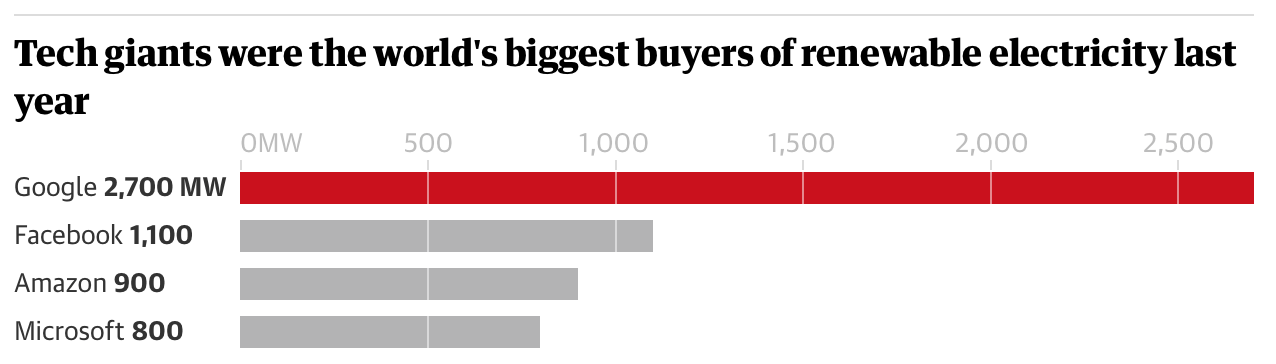
Source: 2019 BloombergNEF
For very long now, much of the focus has been to influence the source of energy powering the cloud – such as the move to renewable datacentres with the adoption of solar & wind energy. This creates its own set of challenges. Globally, demand outpaces supply in that we have an infrastructure shortfall desperate to meet the demands of the exponential growth in data. This has been further accelerated by the COVID-19 crisis with the world embracing remote-working, which in turn impacts global warming and overall GHG emmissions.
For example, everyone of us reading this blog is also an email user & creates approximately 600kg of CO2 / year on average. Unfortunately, most of that is powered by servers sourced from fossil fuels. Now, what if that werent the case and all our emails were powered by renewable energy sources all of the time. It negates the impact instantly.

When you extrapolate that to the 2.9 Billion email users on
the planet, emails alone account for
nearly 4% of global warming.
In the midst of this battle for sustainable cloud solutions, Google has been chipping away at this problem using their inherrent strength in data & analytics. They have cleverly repositioned data clusters on servers by prioritising workload requirements to synchronise with renewable energy sources.
They call this framework a carbon intelligent cloud. For example, peak workloads can be prioritised onto server grids which are 100% powered by renewable sources of energy, such as wind or solar. Other non-essential computations can be carried out at a later point in time when excess sources of renewable energy are available. This simple move to marry workloads to renewable energy sourced data processing servers dramatically reduces the carbon footprint of the cloud industry.

Google promises to release periodic findings from their experiences following their launch last month. In the days ahead, you can expect other cloud providers to reprogram their workload allocations in much the same way and help reduce carbon emmissions.
This is also good news for corporate clients & cloud consumers who are under increasing pressure & scrutiny to improve their sustainability footprint even as their data needs rise exponentially.
Fortunately, the cloud industry is perhaps best equipped to handle this growing dichotomy – it was born to deliver maximum change & innovation in the shortest available timeframe.
Guest Contribtion by: VASU GUPTA, GOOGLE CLOUD
Guest contribution by Mars
We frequently get questions on the importance of ‘Cultural Diversity’ in how it relates to business.
‘Culture’ is a critical ingredient for any thriving ecosystem. Simply put, it is the ‘Sum of Us’. It’s what we become as a result of our thoughts & actions. It evolves and it is dynamic. It grows and permeates the subconscious as we imbibe values & learnings from one another.
This cultural lifecycle has a logical flow with the propensity for change directly proportional to the size of the groups. Smaller, more cohesive gatherings are more in sync with a changing culture, and as they grow, have less influence over the collective.
Organisational culture works in much the same way. As companies expand, they constantly add new experiences from incoming employees which fuses fresh thinking into the existing pool. This stage, when managed with care, can be a game changer for most companies – organisations could either slip and stumble or become a cohesive force developing momentum towards accelerated growth. That is why strong gate-keepers of good organisational culture are critical. These custodians ensure the continuous inflow of diverse thinking to add to what is currently absent.
To some organisations such as Mars Inc, this comes quite naturally. Last month, EARTH 51 were privileged to participate in their World Cultural Diversity week celebrations – a tremendously powerful visual of diverse cultures coming together to celebrate their differences. It was a huge learning for us to watch first-hand, an organisations’ 109 year evolution path, and a lesson in how to stay lock-step with a forever changing world.

Mars Inc is a strong reference on how diversity of thought can be central to an organisations’ success. After all, fostering innovation from multiple idea pools helps organisations mirror their clients needs. This gives companies such as Mars Inc an accurate representation of their target markets – employees who think, feel, understand & react to their consumer’s sentiments. What better way to stay connected with the needs of today, as well as course-correct for future demand.
“Sustainable in a generation”
We observe that the stronger the organisational linkage with a purpose-led vision, the more culturally rich & diverse they tend to be. Mars Inc for instance, has a vision to achieve “Sustainable in a generation”. Their every objective is laser focussed on making a difference to both people and planet. This fore-sight is perhaps the underpinning reason for a company such as theirs to grow profitably, ethically & responsibly for over a century & to usher in 2020 as one of the most sustainable companies on our planet today.
Finally, adding to the moral argument, there is a tremendous macro-economic benefit accrued by companies that embrace diverse cultures.
In the UK, companies that are able to grow their cultural diversity by 10%, average an EBITDA growth of 3.5%. In another study by McKinsey in 2019, companies that were both gender & ethnically more diverse had a 36% likelihood of outperforming their peers on profitability alone.
This direct correlation reinforces the point that sustainable, culturally diverse companies are resilient, adaptable, and are more profitable in the longer-term maintaining a closer connect with their customer base.
Its also in their DNA to consistently chase a vision of ‘becoming better businesses for a better world.’